

We’re looking back at our involvement with Autism in Schools (AIS) and Partnerships for Inclusion of Neurodiversity in Schools (PINS) since the projects started in January 2024.
While the PINS project has, sadly, come to an end, we’re delighted that Autism in Schools is continuing to July 2028. These NHS-funded projects aim to improve children’s experiences at school and nursery by:
- offering better support for parent carers via groups at school and nursery
- improving support for children by hearing their experiences and ideas (AiS project only)
- providing training and support for school staff.
For this coming school year 2026/27, we are hoping to work with five schools that will be new to the Autism in Schools project, as well as a 6th Form College. We will share these details once confirmed.
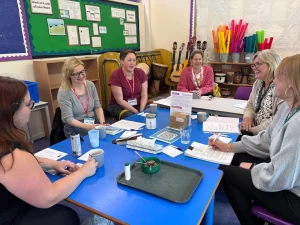
ESPCF’s involvement is to work with schools and nurseries to hold groups for parent carers to share experiences, chat about what is going well or not so well, hear about information and resources, and discuss ways to improve support.
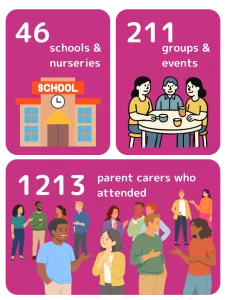 In total, we have worked with 46 schools and nurseries in East Sussex, held 211 groups and events, and spoken with 1213 parent carers.
We’re previously written about some of the messages we’ve heard from parent carers at the group as well as the ideas for making small changes at school. Here’s a round up of the more recent messages and themes parent carers are sharing with us.
Emotionally based school avoidance (EBSA) / emotionally based school non-attendance
We heard from many parent carers who told us how much they struggle with their child’s children’s attendance at school. In some cases, the children are ‘fine’ in school once there but then have a fall out at the end of the school day which often results in dysregulation and distressed behaviours that can be difficult to support.
Many parent carers mentioned how very isolated they feel and that others don’t see and often don’t understand the effort that goes in to trying to get their child into school. One parent carer reported that she is now feeling supported by the school who are helping to reintegrate her child, but that her child is still largely out of school.
Resources:
Not Fine in School A team of parents of children who have experienced school attendance barriers and who offer advice and support
Children out of school – your top questions answered Questions and answers from IPSEA (Independent Provider of Special Education Advice) webinar
Children not in school Information page from Amaze
EBSA resources including toolkit Information on East Sussex County Council’s Czone page
CAPA First Response Free, specialist, tailored support for parents and carers of children—including neurodivergent young people up to 25 years old – around the challenges that come with child-to-parent aggression and harmful behaviours
Short breaks and holiday clubs
Accessing holiday clubs for neurodivergent children sems to be a continuing problem. Lack of staff training and understanding from the staff who run them was highlighted. Parent carers said it would be helpful to have some signposting to support which would list inclusive holiday groups. One parent shared a concern about her son with being bullied and misunderstood, and other parents spoke about the difficulties of their children being seen as different and being made fun of.
A discussion was had at one group about the Oliver McGowen training and that it would be good if this or similar training was mandatory for staff who run playschemes and holiday clubs.
East Sussex HAF (Holiday Activities and Food) sessions
We’re aware that a live issue at the moment is around access to the East Sussex Holiday Activities and Food (HAF) sessions. It is currently being presented as the alternative to the previous free school meal vouchers issued to eligible families during school holidays. Still, we also know this further highlights issues we have heard about for a while now around accessibility for SEND children and young people.
Have you used any of the East Sussex HAF (Holiday Activities and Food) sessions this year? Or maybe you have been unable to access them, or there have been other barriers? It would really help us if you could take 5 minutes to answer a short survey about the HAF scheme to help us work with the council or providers to improve access in future.
ESPCF will take all of this feedback to the regular meetings with the commissioner responsible for short breaks.
Managing dysregulation
The engagement staff have held several parent carer school groups with the theme of managing dysregulation. Parent carers said they found the group really helpful and were keen to try strategies which might work for them.
Transitions, particularly after school, were noted as a key issue. Some parents were familiar with sensory needs and potential speech and language needs as a contributing factor (particularly processing when dysregulated), but many weren’t and found the groups helpful and would like more of these groups.
Parent carers commented on how important peer support was and how much it helped not feeling alone. They also talked about things that schools could put in place to help prevent after school dysregulation such as an earlier finish, soft start/endings, and pop-up sensory dens.
And finally
We bid farewell to our ESPCF engagement worker Belle who joined us almost a year ago and hit the ground running with supporting our school groups. Belle has now moved on to a new role and we wish her and her family all the best for the future. Thank you, Belle!